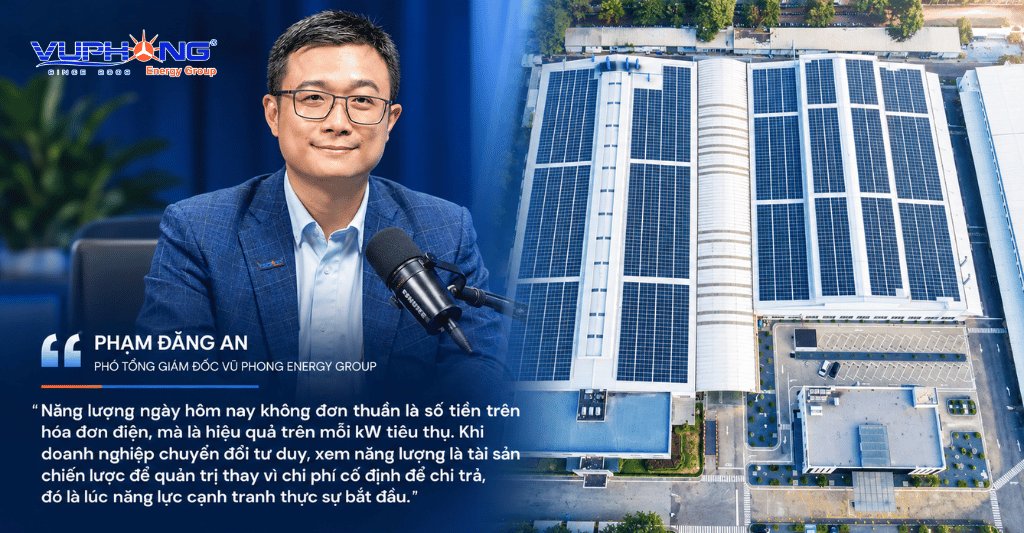
Energy is becoming a new competitive advantage for manufacturing businesses
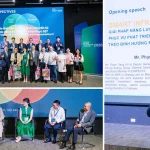
In Episode 4 of the Future Tech Podcast, part of Vietsuccess’ Business Insize program, Mr. Pham Dang An – Deputy General Director of Vu Phong Energy Group, General Director of Vu Phong Energy Group, and a member of the Board of Directors of EVNPC3 – engaged in an in-depth conversation on the energy challenge facing manufacturing businesses.
As Vietnam’s economy enters a new phase of growth, accompanied by the rapid expansion of Artificial Intelligence (AI), which requires data centers to operate with increasing stability and power, building a stable, intelligent, and sustainable energy system is no longer simply an option. It has become a foundation for businesses to strengthen their competitiveness in the technology era.
In this context, the question is no longer simply, “How much electricity does a business need?” Instead, it has become: How efficiently does a business use electricity? Where does its clean power come from? And how can energy create a competitive advantage for the business? These were also the key themes throughout the conversation between Mr. Pham Dang An and host Thu Binh in Episode 4 of Vietsuccess’ Future Tech Podcast.
Click the link to watch the Podcast: https://www.youtube.com/watch?v=qdHC0fYXwQA
The journey into the energy industry
Few people know that before entering the energy sector, Mr. Pham Dang An once started his career as an entrepreneur in the tea industry. A turning point came after several years of working in the field, when he had the opportunity to participate in a program that provided solar-powered lamps to people living in remote and underserved areas where access to electricity remained difficult.
That experience raised a seemingly simple but profound question:
“How would we live without electricity?”
From that question, Mr. An began to view energy not only from a technical perspective, but also through the lens of economics, society, and development. After nearly a decade in the power industry, he believes one of the biggest changes has been the increasing diversity and coordination of energy systems. Electricity is no longer simply a matter for the power sector. Energy is closely connected to policy, finance, end users, technology, and increasingly, emissions reduction. For manufacturing businesses in particular, energy is directly linked to Scope 2 emissions – indirect emissions generated from the electricity a business purchases and consumes.

Making the green transition practical
One of the most notable points from the conversation was the changing way businesses perceive renewable energy.
According to Mr. An, the drive toward greener operations is no longer motivated solely by the desire to build a sustainable corporate image. Increasingly, the pressure is coming directly from markets, customers, and global supply chains.
When major brands establish emissions-reduction targets across their entire supply chains, those requirements are gradually passed down to their suppliers. Manufacturing businesses therefore need to meet not only requirements related to quality, cost, and delivery, but also demonstrate their ability to comply with environmental standards.
This is particularly significant for Vietnamese businesses participating in global supply chains.
During the conversation, Mr. An expressed the issue in very direct terms: businesses can choose to move toward greener operations together, or face the risk of no longer being prioritized within the supply chain.
In other words, green energy is shifting from a strategic option to a factor that can directly affect a company’s ability to access markets and secure orders.
Don’t start by installing solar power
One of the key messages from the podcast is that an energy strategy should not begin with the question, “What system should we install?”
According to Mr. An, before choosing solar power, BESS, I-REC, DPPA, or any other solution, businesses first need to take a closer look at their own operations.
How much are they currently producing? What are their expansion plans over the coming years? How much does electricity account for in their product costs? Are there unusual patterns in their electricity consumption? Which kilowatt-hours are being used efficiently, and where is energy being wasted?
One of the fundamental data points highlighted by Mr. An is the load profile – a representation of electricity demand over different periods of time. It allows businesses to understand how they actually use electricity rather than simply looking at their monthly electricity bills.
Only then can the energy challenge be considered alongside the broader business challenge.
An energy project can become a long-term asset for a business over a period of 20–25 years. Therefore, an investment decision made today should not only address current energy needs but also support the company’s development strategy for many years to come.
AI will transform how factories manage energy
Another notable part of the conversation was the role of AI in energy management.
According to Mr. An, AI can help businesses continuously monitor electricity consumption, detect anomalies, forecast energy demand based on production plans, and support the development of different investment scenarios.
AI can also be applied to predictive maintenance, operational optimization, and the analysis of data collected from multiple factories.
However, Mr. An emphasized an important principle: AI can support decision-making, but it does not replace people in making decisions or taking responsibility for them.
This reflects a broader trend that Vietnamese businesses are increasingly pursuing: the dual transformation – digital transformation alongside green transformation.
Zero-CAPEX: The great solution for energy and finance
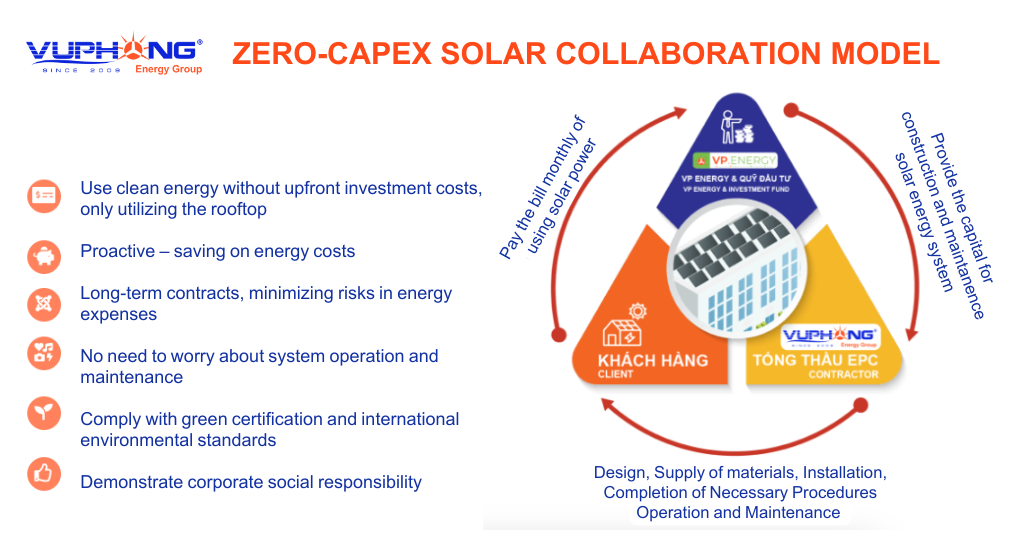
One of the major barriers businesses face when investing in green energy is the initial capital requirement.
An energy project can require a significant upfront investment, while businesses also need to prioritize capital for machinery, raw materials, factory expansion, and their core production activities.
This is why the Zero Capex model was highlighted by Mr. An as a noteworthy approach.
Instead of requiring businesses to make a large upfront investment in an energy system, the model allows a specialized provider to participate in financing, developing, and operating the system. This enables businesses to access clean energy without having to allocate a significant amount of initial capital.
Once again, however, the solution is not simply about “installing a system.” The key is to design a model that fits the specific business needs and cash flow of each company.
Energy as the backbone of the factory of the future
Towards the end of the conversation, Mr. Pham Dang An envisioned a future in which renewable energy is distributed across individual factories, industrial parks, and industrial clusters.
Each factory could achieve a certain level of energy self-sufficiency by combining solar power, energy storage systems, or other energy solutions depending on its specific needs.
In this future, energy would do more than simply power production. It could become a fundamental source of competitiveness for Vietnam’s manufacturing industry.
The final message of the podcast, therefore, is not about whether businesses should choose solar power, BESS, I-REC, DPPA, or Zero Capex.
What matters more is that businesses understand where they stand before deciding which direction to take.
The three steps highlighted by the program begin precisely there:
Audit the business. Identify the business challenge. Then select the appropriate energy solution.
————–————–
The Future Tech episode featuring Mr. Pham Dang An is currently part of the Vietsuccess content ecosystem and can be accessed through podcast platforms including Spotify and Apple Podcasts.
► YouTube: https://youtu.be/qdHC0fYXwQA
► Spotify: https://bit.ly/3qV93Jg
► Apple Podcasts: https://bit.ly/406AsVH
Recent Posts
-
 Energy is becoming a new competitive advantage for manufacturing businesses
 -
Vũ Phong Energy Group Advances Energy Infrastructure for the AI and Data Center Era On July 29, as part of the Vietnam Global Innovation Connect 2026 (VGIC 2026), Vũ Phong
-
Vu Phong Energy Group, Solplanet and Jinko Solar Successfully Organize Basic Solar Technical Training Course 1
-
The Handshake of Two Harmonious Philosophies: Vu Phong Energy Group and Solplanet
-
Vu Phong Energy Group Participates in VEPG Panel Discussion