The EVN transitional energy price framework has been a critical topic for stakeholders in Vietnam’s renewable energy sector. Vietnam Electricity (EVN) has formulated four distinct options for calculating the price frameworks applicable to transitional wind and solar power projects. These calculations are based on comprehensive input data provided by investors, including crucial metrics like investment rates, power forwarding capacity, corporate income tax incentives, and loan structures. This proposal, submitted to the Ministry of Industry and Trade (MOIT), aims to establish clear and viable renewable energy tariffs, shaping the financial landscape for numerous projects awaiting grid connection and a definitive pricing mechanism. Understanding these methodologies is essential for investors and developers navigating the evolving regulatory environment for solar and wind power price in Vietnam.
Vietnam Electricity (EVN) has developed four distinct options to calculate the price frameworks for transitional wind and solar energy projects. These calculations depend on key input data supplied by investors, such as investment rates, average power forwarding, corporate income tax, foreign versus local currency loan ratios, and the associated interest rates for these loans.
EVN’s Proposed Calculation Methodologies
Option 1
Under this option, the total investment value is considered smaller than the value derived from basic and technical designs. The investment rate is set at 90% of the investor’s stated rate, effectively excluding a 10% reserve value. EVN’s calculation assumes a foreign-to-local currency loan ratio of 20-80%. The interest rates used are based on those from power plants that signed power purchase contracts between 2017 and 2021, ranging from 4.62% to 9.87% per year.
The corporate income tax rate is calculated at an average of 8.25% after applying all incentives. This assumes a preferential rate of 10% for the first 15 years, a 4-year tax exemption (0%), a 50% tax reduction for the next period (5%), followed by a 10% rate for the subsequent 2 years, and a standard 20% rate thereafter.
Based on this methodology, the average power generating price per kWh is projected as follows:
- Ground-mounted solar power: 1,482.74 VND
- Floating solar power: 1,740.84 VND
- Onshore wind power: 1,590.88 VND
- Offshore wind power: 1,971.12 VND
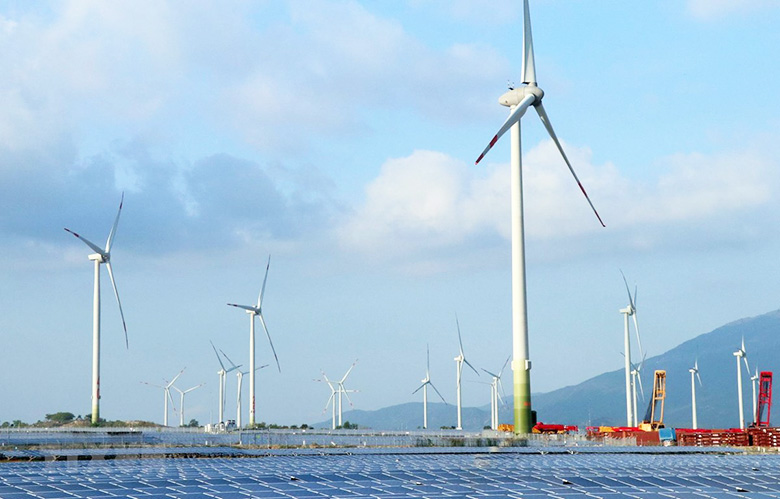 The generating price framework for the transitional solar and wind power plants has been submitted by EVN to the Ministry of Industry and Trade.
Option 2
EVN calculates this option using input parameters similar to Option 1, but the investment rate is determined by the average calculated rate of related power plants. This adjustment in the EVN price calculation methods leads to a different solar power price in Vietnam. The resulting power generating prices per kWh are:
- Ground-mounted solar power: 1,508.39 VND
- Floating solar power: 1,569.83 VND
- Onshore wind power: 1,597.55 VND
- Offshore wind power: 1,944.91 VND
Option 3
This option also uses parameters similar to Option 1, but it assumes that investment rates and power output vary according to a Gauss standard distribution. The value is determined as the figure supplied by the investor that is closest to the expected value. Under this model, the power generating prices per kWh are:
- Ground-mounted solar power: 1,508.76 VND
- Onshore wind power: 1,630.21 VND
- Offshore wind power: 1,973.99 VND
Data was insufficient to calculate a price for floating solar power under this option.
Option 4
For this option, EVN specifically calculates the price for the Phuoc Thai 2 and 3 solar power plants. The calculation updates the investment rate with the total investment value post-bidding and includes the shared cost of the 220 kV substations for the Phuoc Thai 1, 2, and 3 plants. The resulting energy production cost per kWh is 1,187.96 VND for Phuoc Thai 2 and 1,251.66 VND for Phuoc Thai 3, respectively.
EVN’s Final Recommendation on Renewable Energy Tariffs
Based on these comprehensive calculations, EVN proposed to the Ministry of Industry and Trade that the power generating price framework for each type of plant be set at the lowest price obtained from the four options. The recommended prices are as follows:
| No | Power plant type | Proposed Price (VND/kWh) |
| 1 | Ground mounted solar power plants | 1,187.96 |
| 2 | Floating solar power plants | 1,569.83 |
| 3 | Onshore wind power plants | 1,590.88 |
| 4 | Offshore wind power plants | 1,944.91 |
Regulatory Context and Next Steps
EVN has clarified that the calculating parameters are based on its internal assumptions and require verification and a final decision from the Ministry of Industry and Trade. Due to the urgent nature of the request from MOIT, EVN did not have sufficient time to engage independent consultants to validate the price framework before submission. Consequently, EVN has recommended that MOIT utilize independent experts or an advisory council to carefully review its calculations and proposals before granting approval. This approved framework would then serve as a basis for determining electricity prices through competitive mechanisms or auctions.
This process was initiated following the issuance of Circular No. 15/2022/TT-BCT by the Ministry of Industry and Trade, which took effect on November 25, 2022. The circular outlines the methodology for constructing a power generating price framework for these transitional projects. It required investors of specified solar and wind projects with contracts signed before early 2021 to submit their feasibility studies or technical designs to EVN.
EVN sent information requests to over 240 renewable energy plants and received responses from 208 of them by November 16. The data from these 208 plants, including 95 ground-mounted solar plants, 4 floating solar plants, and 109 wind power plants, was used to construct the proposed power generating price framework submitted for evaluation.
Vu Phong Energy Group
Recent Posts
-
 Vũ Phong Energy Group Advances Energy Infrastructure for the AI and Data Center Era On July 29, as part of the Vietnam Global Innovation Connect 2026 (VGIC 2026), Vũ Phong
 -
Vu Phong Energy Group, Solplanet and Jinko Solar Successfully Organize Basic Solar Technical Training Course 1
-
The Handshake of Two Harmonious Philosophies: Vu Phong Energy Group and Solplanet
-
Vu Phong Energy Group Participates in VEPG Panel Discussion
-
Vũ Phong Day 2026 – Taking action to build the future