UPDATE 2022: As clean energy technology continues to advance, we are witnessing increasingly innovative approaches to creating truly sustainable and eco-friendly products. This drive towards a circular economy and responsible consumption is transforming various industries, especially transportation, paving the way for groundbreaking sustainable solutions.
Unveiling the Solar-Powered Electric Vehicle Made from 3D Printed Garbage
One of the most compelling recent examples of this technological progress is the pioneering solar powered electric vehicle constructed entirely from 3D printed garbage. This revolutionary concept demonstrates a profound shift in sustainable product design and waste management innovation. In this article, we will delve deeper into this unique renewable energy vehicle, exploring its creation, its remarkable journey, and its significant contribution to a more sustainable future.
This particular solar powered electric vehicle, ingeniously crafted from 3D printed garbage, stands as a testament to truly revolutionary engineering. It has been meticulously designed to be both environmentally sustainable and highly eco-friendly. This innovative vehicle is constructed entirely from reclaimed waste materials, which have been expertly processed and 3D printed into its functional components. Powering this incredible feat of solar electric vehicle technology are high-efficiency solar panels strategically mounted on its roof, showcasing a practical application of renewable energy.
The Genesis of a Sustainable Transportation Innovation
The ambitious creation of this sustainable transportation solution was the result of a collaborative effort, bringing together a dedicated team of visionary engineers, creative designers, and committed environmentalists. Their overarching goal was to conceptualize and build a vehicle that was not only inherently sustainable but also economically affordable and broadly accessible to communities worldwide, addressing critical aspects of the circular economy solutions.
To successfully achieve this challenging objective, the team harnessed the power of advanced 3D printing technology. They utilized a specialized industrial printer capable of working with recycled materials, transforming common waste products such as plastic bottles, discarded bags, and other refuse into robust, usable components. This innovative approach to green transport solutions exemplifies cutting-edge sustainable product design.
The intricate process involved individually printing each necessary part, followed by their meticulous assembly to form the complete vehicle. This highly customizable manufacturing method not only ensured the vehicle’s sustainable credentials but also allowed for precise adaptation and optimization, pushing the boundaries of how to make an electric car from recycled plastic.
 Modular HexCore building blocks forming the vehicle’s structure.
As articulated by the pioneering team:
“We meticulously shredded waste pieces and melted them into the filament that feeds our 3D printers. We then scaled this process to an industrial level, utilizing recycled pellets sourced directly from a waste processing plant. With a fleet of forty 3D printers operating simultaneously, we produced 4000 HexCores—innovative building blocks inspired by the natural strength and lightweight properties of honeycomb structures.”
These ingeniously designed building blocks were subsequently integrated to construct the primary structure of their groundbreaking electric vehicle.
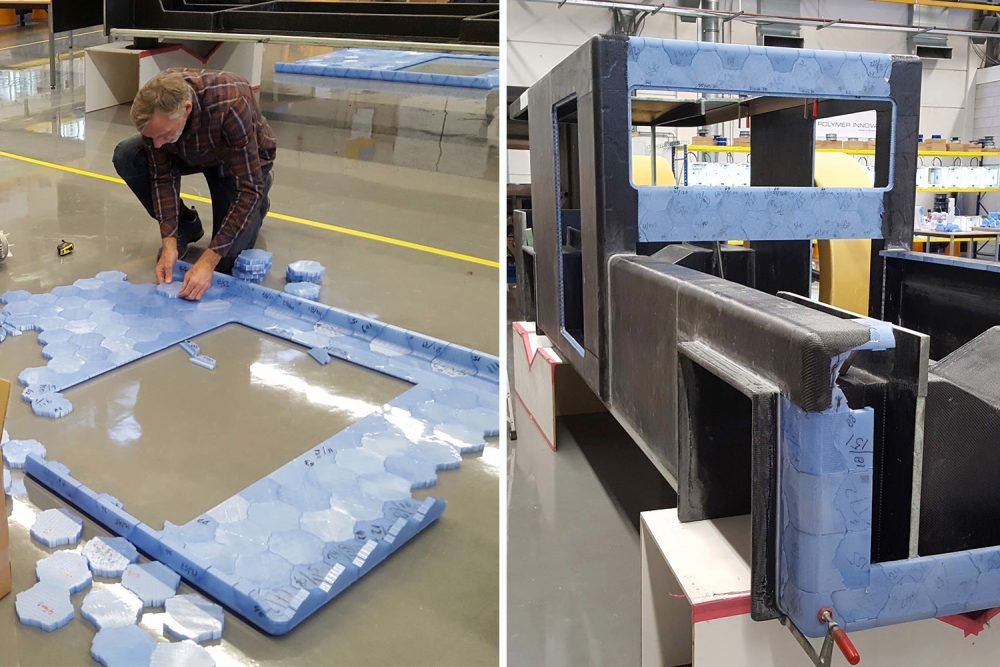 The HexCore puzzle pieces come together to form the Solar Voyager.
Once the robust shell of the Solar Voyager was meticulously assembled, the integration of its advanced technological systems was completed.
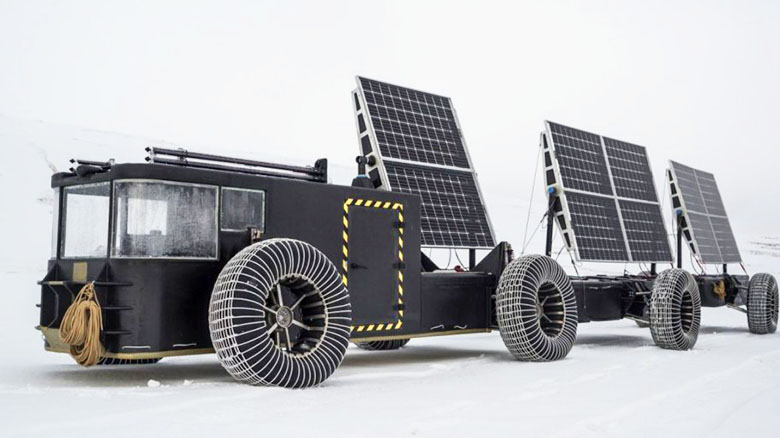
The Solar Voyager, designed for extreme conditions, ultimately comprises a four-wheeled buggy that tows a pair of specially designed two-wheeled trailers.
These trailers not only support 10 high-efficiency bifacial solar panels, which maximize energy capture, but also cleverly store essential supplies, including a 47-day reserve of food for the expedition team. This thoughtful design highlights the capabilities of solar powered vehicles for extreme conditions.
Rather than carrying heavy water reserves, the team ingeniously utilizes the surrounding ice for drinking water, which is melted using six advanced solar vacuum tubes, showcasing practical renewable energy applications in challenging environments.
Furthermore, infrared windows are strategically installed in the cab, designed to efficiently absorb sunlight and maintain a comfortable internal temperature, optimizing energy efficiency and crew comfort during the arduous journey.
 The Solar Voyager traversing challenging landscapes.
Weighing in at 1,485 kg (3,274 lb), the Solar Voyager is remarkably lightweight considering the extensive gear required for both its propulsion and the survival of its occupants. This reflects innovative sustainable product design.
The Solar Voyager stretches an impressive 16 meters (52 ft) in length and moves at a deliberate speed of 8 km/h (5 mph). This optimized, slower speed is crucial for maximizing the efficiency of the power generated by its solar panels, ensuring sustained operation in remote areas. This careful balance between speed and energy consumption is key to the future of sustainable vehicle manufacturing.
 An aerial perspective showcasing the Solar Voyager’s design and solar panel array.
The sophisticated design of the solar powered electric vehicle was not without its share of formidable technical challenges, as candidly explained by the development team:
“Operating a vehicle in Antarctica demands exceptional creative problem-solving. We had to address fundamental questions: How do we achieve flotation on deep snow, and how do we provide a constant supply of drinking water? Moreover, establishing reliable communication with the Mission Control Center was paramount. Our solution involved ten solar panels ensuring a consistent power supply for the engine, complemented by vacuum tubes specifically designed to melt ice for water. The vehicle’s lightweight construction, distributed across specialized wheels, significantly enhances driving efficiency. What began as a complex plastic puzzle has evolved into a high-tech vehicle purpose-built for the extreme conditions of Antarctica exploration.”
Through rigorous testing, including a successful shakedown run in Iceland, the team meticulously resolved all technical intricacies of the Solar Voyager, ensuring its readiness for its ambitious mission.
The Transformative Journey of the Solar Voyager
In a five-week expedition, the team will embark from their Antarctic base camp, navigating the challenging terrain to reach the geographic South Pole. From this pivotal point, they will commence their return journey, aiming to complete a total distance of 2,400 km (1,491 mi). If all aspects of the mission unfold as planned, this extraordinary journey is projected to span approximately 30 days, serving as a powerful statement on environmental protection.
Throughout this demanding expedition, the team will confront summer temperatures plummeting to -30ºC (-22ºF), along with the unique phenomenon of 24-hour sunlight—a crucial advantage for a solar powered electric vehicle.
For those wondering, “Why Antarctica?”, the team provides a compelling rationale for choosing this remote and unforgiving continent, beyond typical solar races in the US, Europe, and Asia. Antarctica holds profound significance for their mission:
“Antarctica, which encompasses 90% of the world’s ice, remains an international territory, belonging to no single nation. By law, it is designated as a zero-waste environment, making it the quintessential destination for a zero-waste adventure. Our journey seeks to draw lessons from Antarctica and advocate for the preservation of its pristine state. We also aim to elevate global awareness regarding the Antarctic Treaty; its non-extension in 2048 would potentially open the continent to commercial exploitation, underscoring the urgency of our environmental advocacy.”
Ultimately, the solar powered electric vehicle, ingeniously manufactured from 3D printed garbage, stands as an innovative and eco-friendly product. It brilliantly showcases how advanced technology and waste management innovation can significantly contribute to a sustainable future, embodying the principles of a circular economy. The Solar Voyager, a unique vehicle born from recycled materials and propelled by solar power, was designed to conquer extreme technical challenges while simultaneously promoting sustainable living and global environmental awareness. Vu Phong Energy Group is proud to highlight such advancements in renewable energy vehicles.
Recent Posts
-
Vũ Phong Magazine – September 2026: Strategic Partnerships and Green Energy Transition in Focus
-
C47 Inaugurates Representative Office in Laos and Announces the Establishment of C47 Energy Laos: A Strategic Milestone in Its International Expansion
-
Solar Energy Businesses Strengthen Cooperation to Expand the Renewable Energy Solutions Ecosystem
-
 Energy is becoming a new competitive advantage for manufacturing businesses
 -
Vũ Phong Energy Group Advances Energy Infrastructure for the AI and Data Center Era On July 29, as part of the Vietnam Global Innovation Connect 2026 (VGIC 2026), Vũ Phong