Renewable energy investment reached unprecedented levels in the first half of 2022, signaling a robust global commitment to clean energy transition. This article delves into the significant financial flows observed across solar and wind power sectors, examining the key drivers behind this record-setting growth, despite economic headwinds. Drawing insights from authoritative sources like BloombergNEF and the International Energy Agency, we explore the evolving landscape of global clean energy investment and project its future trajectory. Furthermore, we highlight Vietnam’s strategic role and ambitious targets in advancing its own renewable energy development, offering a comprehensive overview for readers interested in sustainable energy growth and climate goals.
Global Renewable Energy Investment Continues to Set Records
In the first six months of 2022, global renewable energy investment achieved a new record of $226 billion, demonstrating a surging investor interest in clean energy solutions. According to BloombergNEF, this figure represents a significant 11% increase compared to the same period in 2021, underscoring the dynamic growth in the sector. Among the various technologies, solar power investment led the charge, reaching an impressive $120 billion, a substantial 33% rise year-over-year. Wind power investment also saw robust growth, attracting $84 billion, an increase of 16% over 2021 figures. This remarkable expansion in both solar and wind power development occurred despite challenges posed by rising input prices for critical supplies, ongoing supply chain interruptions, and increasing financing costs.
This sustained growth in global clean energy investment is partly fueled by capital injections from venture capital and private equity (PE) funds, which collectively invested $9.6 billion in the first half of 2022, marking a 63% increase from the prior year. Albert Cheung, Chief Analyst at BloombergNEF, emphasized that the demand for clean energy sources has never been higher, with the global energy crisis acting as a crucial catalyst for accelerating the shift towards sustainable energy. When considering overall renewable energy development, nations like China continue to lead in both solar and wind power investment flows. The United States also showed strong commitment, investing $41 billion in large-scale solar projects and $58 billion in wind power projects. China, in particular, is progressing steadily towards its ambitious emission reduction goals, aiming for a total capacity of 1,200 GW of wind and solar energy by 2030.
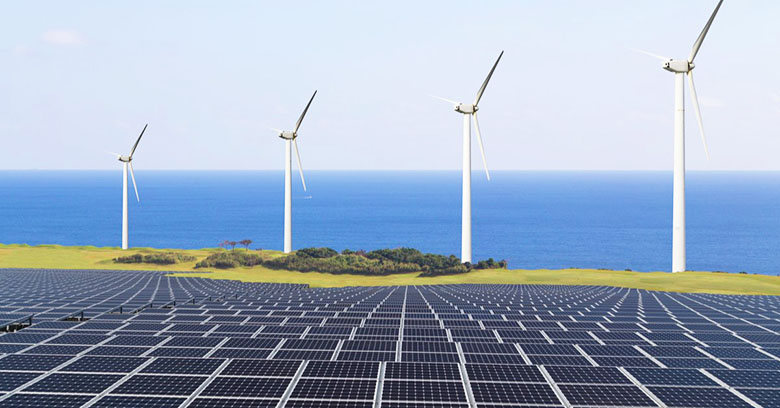
Renewable energy investment continues to set records in the first half of 2022 (Internet Photo)
A noteworthy trend within these investment flows is the significant growth in offshore wind investment. In the first half of 2022, offshore wind projects attracted $32 billion, representing an impressive year-over-year growth of 52%. BloombergNEF analysts predict that investments made in 2022 will predominantly support projects scheduled to commence operations in the coming years. It is anticipated that the installed capacity of offshore wind will expand tenfold by 2035 compared to 2021 levels, increasing from 53 GW to a projected 504 GW. Key nations such as the United Kingdom, France, and Germany have substantially raised their offshore wind capacity objectives in the first half of 2022, signaling a heightened commitment to green investment in this technology. The largest deal recorded during this period was the funding for China’s 1 GW Yangjiang Shapa Qingzhouwu Offshore Wind Farm project, highlighting the scale of these green investments.
Clean Energy Investment in 2022 is Expected to Reach $1,400 Billion
Further underscoring the positive outlook, a new report by the International Energy Agency (IEA) forecasts that global energy investment will grow by 8% in 2022, reaching an estimated $2.4 trillion. Crucially, the IEA clean energy investment forecast indicates that clean energy is expected to account for $1,400 billion of this total. Following the signing of the Paris Agreement in 2015, investments in clean energy saw only a modest increase of approximately 2% per year. However, since 2020, clean energy financing has accelerated significantly, climbing to a 12% annual growth rate, primarily driven by strong government support and sustainable financial trends, particularly within advanced economies. Renewable energy, power grids, and energy storage systems collectively represent over 80% of the total investment within the electrical sector. Moreover, solar power, battery technologies, and electric vehicle investments are rapidly increasing to align with the ambitious 2050 objective of achieving global net-zero emissions.
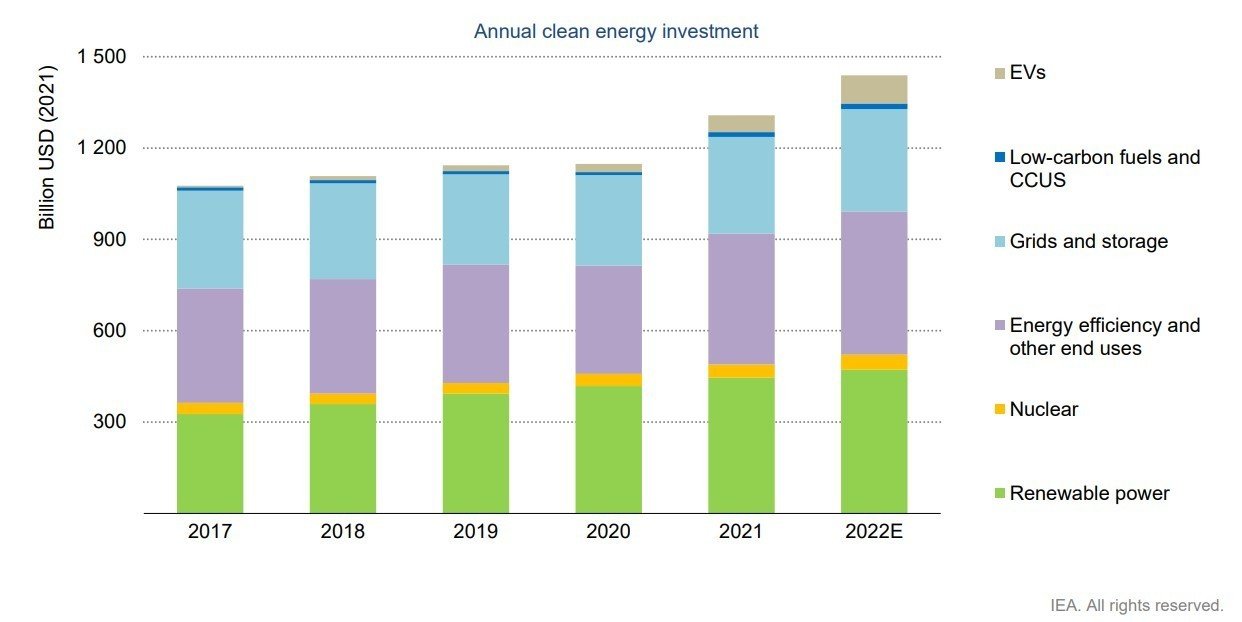
Annual clean energy investment (IEA image source)
While these trends represent a positive step in the right direction for the energy transition, the IEA has cautioned that current renewable energy investment levels have not yet reached the scale required to meet international climate goals effectively. This highlights the ongoing need for intensified efforts and increased capital deployment to achieve global sustainability targets.
|
In Vietnam, the renewable energy sector remains a highly attractive field for investors. This is particularly true given the nation’s robust Vietnam climate change commitments made at COP 26 and its proactive progress in restructuring energy sources. Vietnam prioritizes renewable energy, clean energy, and low-emission sources. In line with the Prime Minister’s Decision No. 896/QD-TTg dated July 26, 2022, which approved the national strategy on climate change for the period to 2050, the proportion of renewable energy sources – including hydropower, wind power, solar power, and biomass – is targeted to account for at least 33% of total electricity generation by 2030. Looking further ahead, by 2050, renewable energy sources are mandated to comprise at least 55% of the nation’s power generation mix. Achieving this ambitious objective necessitates substantial investment. Commentary from many industry experts suggests that clear, certain, and long-term mechanisms and policies will be instrumental in attracting more investment capital into the clean energy sector. Such an environment is crucial for fostering a developed and sustainable market capable of meeting Vietnam’s growing electricity demand and its overarching goal of achieving sustainable economic growth. |
Vu Phong Energy Group
Recent Posts
-
Vũ Phong Magazine – September 2026: Strategic Partnerships and Green Energy Transition in Focus
-
C47 Inaugurates Representative Office in Laos and Announces the Establishment of C47 Energy Laos: A Strategic Milestone in Its International Expansion
-
Solar Energy Businesses Strengthen Cooperation to Expand the Renewable Energy Solutions Ecosystem
-
 Energy is becoming a new competitive advantage for manufacturing businesses
 -
Vũ Phong Energy Group Advances Energy Infrastructure for the AI and Data Center Era On July 29, as part of the Vietnam Global Innovation Connect 2026 (VGIC 2026), Vũ Phong