Circular Economy Vietnam is emerging as a pivotal strategy for the nation’s ambitious sustainability goals. On June 28, 2022, during the “Inception Conference to develop National Action Plan for implementing Circular Economy in Viet Nam”, Minister of Natural Resources and Environment Tran Hong Ha underscored its critical importance. He stated, “Circular economy is the solution so that we can continue to firmly believe on the path to sustainable development, along with the green economy and low carbon economy.” This article delves into the urgent need for Vietnam to embrace a circular economy, detailing expert recommendations and its profound benefits for achieving Net Zero emissions by 2050 and fostering comprehensive sustainable development.
Urgent issues for Net Zero goals and sustainable development
Opening the “Inception Conference to develop National Action Plan for implementing Circular Economy in Viet Nam”, Minister of Natural Resources and Environment Tran Hong Ha elaborated on the numerous benefits and profound importance of the circular economy model. He highlighted its urgent role in the context of intensifying climate change impacts, as Vietnam collaborates with international partners to achieve “Net Zero” net emissions by 2050, alongside the execution of the UN’s Sustainable Development Goals (SDGs).
A May 2022 report from the World Meteorological Organization revealed alarming records set in 2021 across four key climate change indicators: greenhouse gas concentrations, sea-level rise, ocean heat, and ocean acidification. The United Nations further warns that global ecosystems continue to degrade, with biodiversity declining faster than at any other point in human history. This degradation severely impedes SDG implementation and exacerbates challenges related to climate change, health, food security, and water resources.
To effectively combat climate change and achieve sustainable development, numerous nations, including Vietnam, made significant commitments at COP26 to drastically reduce greenhouse gas emissions, targeting “Net Zero” by 2050. A central tenet of this commitment is the urgent transformation of energy structures, prioritizing clean and renewable energy.
In this pressing context, the circular economy is identified as the foundational “golden key” to assist Vietnam in reaching its Net Zero Vietnam goal. It also significantly contributes to mitigating climate change and environmental degradation, thereby fostering overall sustainable development.
Minister of Natural Resources and Environment Tran Hong Ha emphasized, “The need for a more effective economic model concerning resource usage, climate change prevention, pollution reduction, and environmental deterioration is currently an important issue. That is the circular economy.”
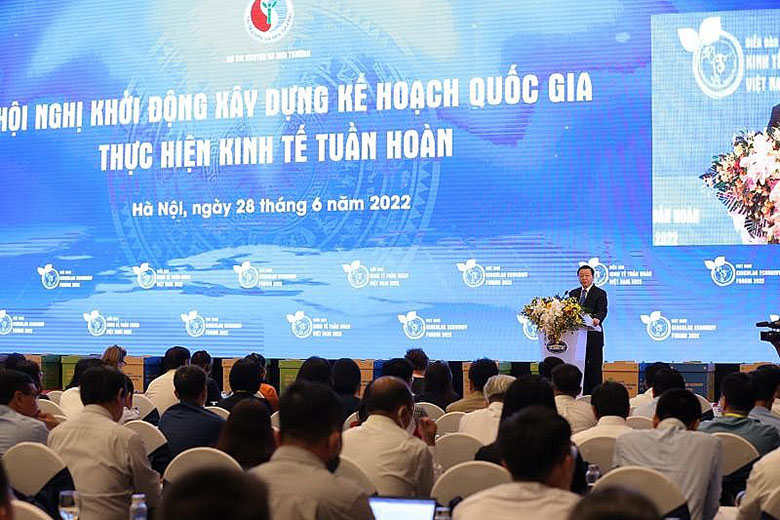
Minister Tran Hong Ha delivers the opening speech at the Inception Conference (Image source: VnEconomy)
According to Minister Ha, developing a circular economy demonstrates the nation’s responsibility in fulfilling its climate change commitments, while simultaneously enhancing the economic competitiveness of both the country and its businesses. The circular economy model offers a multitude of benefits, including the reduction of greenhouse gas emissions across the entire value chain. It promotes the utilization of used materials, minimizing the need for new processing and reducing exploitation of natural resources. This approach also leads to a significant decrease in emissions and solid waste. Furthermore, the circular economy helps alleviate business risks associated with product overproduction and resource scarcity, creating incentives for investment, technological innovation, reduced production costs, and expanded supply chains. Societally, these efforts translate into lower costs for environmental management and protection, enhanced climate change resilience, the emergence of new markets, opportunities, and employment, and substantial improvements in public health.
Many recommendations for developing a circular economy model in Vietnam
During the Conference, numerous valuable circular economy recommendations Vietnam were put forth for advancing the circular economy model. Caitlin Wiesen, the Resident Representative of the United Nations Development Programme (UNDP) in Vietnam, specifically highlighted four key recommendations: Firstly, Vietnam should frame a comprehensive program for green economic recovery post-Covid-19 pandemic, with a strong focus on transitioning to a circular economy. Secondly, promote smart cities and towns. Thirdly, encourage sustainable production and consumption patterns. And finally, concentrate on developing renewable energy to effectively achieve green economic goals.
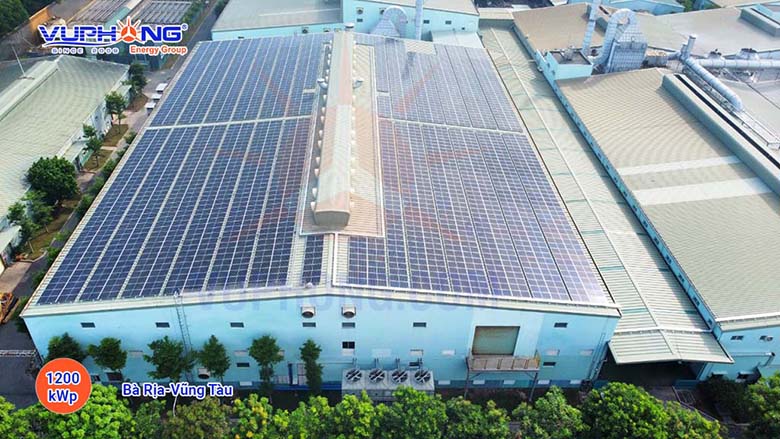
Renewable energy should be prioritized for development to meet green economic targets
Concurrently, Mr. Bui Trung Nghia, Vice President of the Vietnam Chamber of Commerce and Industry (VCCI), provided five specific short- and long-term recommendations aimed at strengthening collaboration between the State, the Government, and businesses in promoting the circular economy. These recommendations include: (1) developing effective mechanisms to encourage the transition to a circular economy model; (2) promoting and actively participating in international cooperation, particularly in agreements and commitments on combating climate change Vietnam and green development; (3) concentrating on establishing successful circular economic models in select key sectors to serve as a basis for wider dissemination and replication; (4) supporting approaches to public-private partnership investment to mobilize diverse stakeholder resources; and (5) investing in enhancing the capacity and role of business representative organizations to improve their ability to gather input, dialogue, provide comments on improving economic institutions and policies, disseminate legal policies, raise awareness within the business community about the circular economy, and assist businesses in international integration with high standards.
“Vietnam must establish policies and take real actions to attract and encourage the participation of many economic sectors and communities to promote green development and reduce emissions,” asserted Mr. Bui Trung Nghia, Vice President of the VCCI.
|
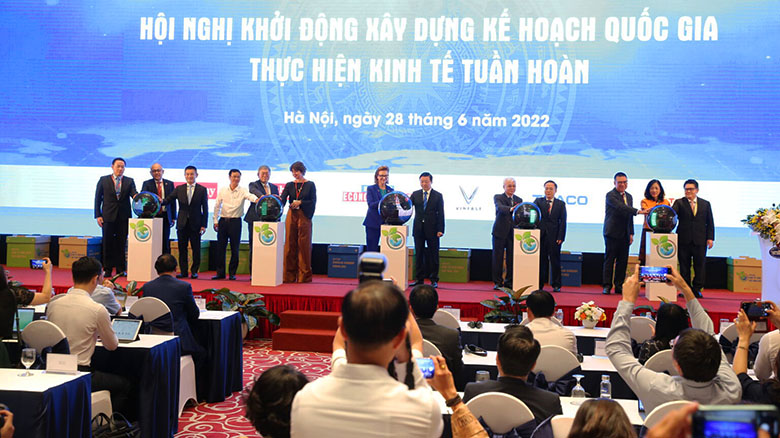
On June 28, 2022, the Ministry of Natural Resources and Environment, in coordination with relevant units, organized the “Inception Conference to develop National Action Plan for implementing Circular Economy in Viet Nam”. This conference held significant importance as it marked the first time such an event on the circular economy was conducted in Vietnam, featuring participation from numerous international organizations, businesses, and leading experts in this economic model. As part of the conference, the Ministry of Natural Resources and Environment and the United Nations Development Programme (UNDP) officially launched the Viet Nam Circular Economy Hub. The establishment of this Hub was a collaborative effort, supported by the Norwegian, Finnish, and Dutch embassies. |
Vu Phong Energy Group
Recent Posts
-
Vũ Phong Magazine – September 2026: Strategic Partnerships and Green Energy Transition in Focus
-
C47 Inaugurates Representative Office in Laos and Announces the Establishment of C47 Energy Laos: A Strategic Milestone in Its International Expansion
-
Solar Energy Businesses Strengthen Cooperation to Expand the Renewable Energy Solutions Ecosystem
-
 Energy is becoming a new competitive advantage for manufacturing businesses
 -
Vũ Phong Energy Group Advances Energy Infrastructure for the AI and Data Center Era On July 29, as part of the Vietnam Global Innovation Connect 2026 (VGIC 2026), Vũ Phong