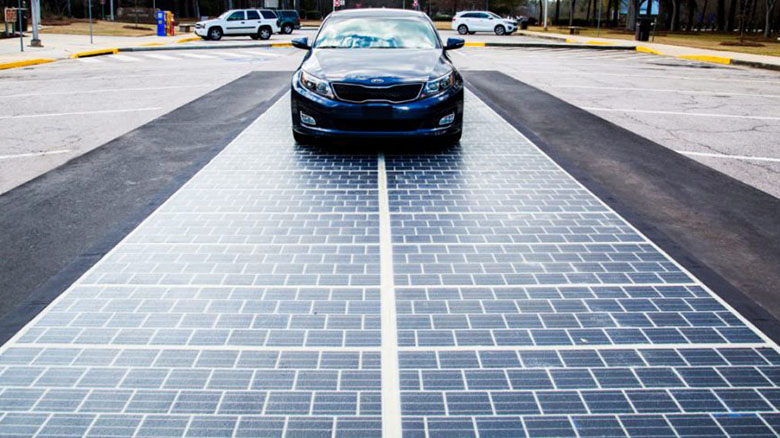
The Ray C. Anderson Foundation in Georgia is determined to push for green highways and reducing emissions through cutting-edge tech like Solar Roads Georgia, despite criticism.
- How Georgia Became A Surprising Bright Spot In The U.S. Solar Industry
- The transportation sector shifts to renewable energy and reduces greenhouse gas emissions
The challenges of implementing solar roads
Although solar roads have received criticism for being ineffective and unpractical, a Georgia charity claims they will still be a component of their research lab for more environmentally friendly roadways. The challenges of solar roads implementation highlight the complexities of adopting such sustainable infrastructure.
“The Ray,” an 18-mile stretch of Interstate 85 in Georgia that features a variety of technologies aimed at reducing emissions and other impacts from transportation, has won praise from across the country. These technologies include right-of-way solar, electric vehicle charging, and strategies to reduce pollution, contributing to the broader goal of zero-carbon transport.
Although testing of solar roadways, which are made of glass and produce power, have shown poor results, neither the foundation nor state authorities are prepared to give up on the photovoltaic technology.
The French transportation firm Colas, in collaboration with the French National Solar Energy Institute, constructed The Ray’s solar road, of which there is presently just a small piece at the project’s tourist center. Just half the anticipated electricity was produced by the initial installation in France. Solar Roadways, a separate project in Idaho, produced much less electricity than anticipated and was not traffic-tested in the real world. While some of the panels were stolen after it was installed, and China won’t tell how much it cost, a solar motorway there may be doing better.
Solar parking canopies and rooftops are more affordable and effective, according to experts.
Dylan Ryan, a lecturer in mechanical and energy engineering at Napier University in Edinburgh, Scotland, asserted that solar roadways are most likely just going to be a specialized source of renewable energy in the future. According to Ryan, “it’s likely that the performance difference between solar highways and regular solar will continue” despite improvements and alterations.
But, The Ray’s board dismisses these criticisms. According to The Ray’s executive director Allie Kelly, they try initiatives out in incubation before moving them forward.
Although smart technology has permeated our lives, she claimed that highways have not kept up. “Our roadways are no match for our microwaves.” She said that by messaging people based on information from the cloud, roadways could possibly charge electric vehicles, power houses and workplaces, illuminate drivers’ paths at night, and keep people safe in a variety of other ways, showcasing potential for infrastructure innovation.
Despite the fact that smart technology has permeated our lives, our roadways have not caught up.
The Wattway panels will need to undergo significant testing before they can be utilized on the local roads. The Ray Foundation emphasizes that they are already doing this.
Kelly explained, “Colas is now working on their third iteration of the panels, which we’ll install this year and replace our present panels with. According to her, the initial version in France had a gap at the joints, which caused a loud, helicopter-like sound to be produced when moving vehicles went over them quickly. Also, the possibility of moisture within the panels is now being eliminated by installing a skid-resistant surface formed from a slurry of recycled glass inside of a controlled production environment.”
The National Center for Asphalt Technology Test Track, a special facility for rapid pavement testing for the Federal Highway Administration, is administered by Auburn University, according to Kelly, who also indicated the foundation is collaborating with them. Using the use of 18-wheeler semi-trucks, the university program condenses ten years of pavement testing into just three. Kelly stated, “We would like to continue collaborating with Auburn for future studies, including testing rubber-modified asphalt, the Wattway, and future road technologies, including wireless [electric car] charging from the pavement,” envisioning future smart roads.
John Hibbard, Director of Operations for the Georgia Department of Transportation, noted that “it will take years before Solar Roads Georgia go to Georgia’s highways.” But he emphasized that The Ray Project is still in the testing phase and thanked the foundation for encouraging the Georgia DOT to try something new, promoting sustainable transportation.
He remarked, “DOTs can take a careful approach. We can take a little bit more risk because of our work with The Ray.”
“The Ray’s board attempts things the state would never sponsor with taxpayer money – at this time,” said Tim Echols, an elected representative on Georgia’s Public Service Commission. Yet since they have the resources and collaborate so effectively, they can turn that section of the roadway into a working laboratory for their initiatives, demonstrating The Ray C Anderson Foundation initiatives.
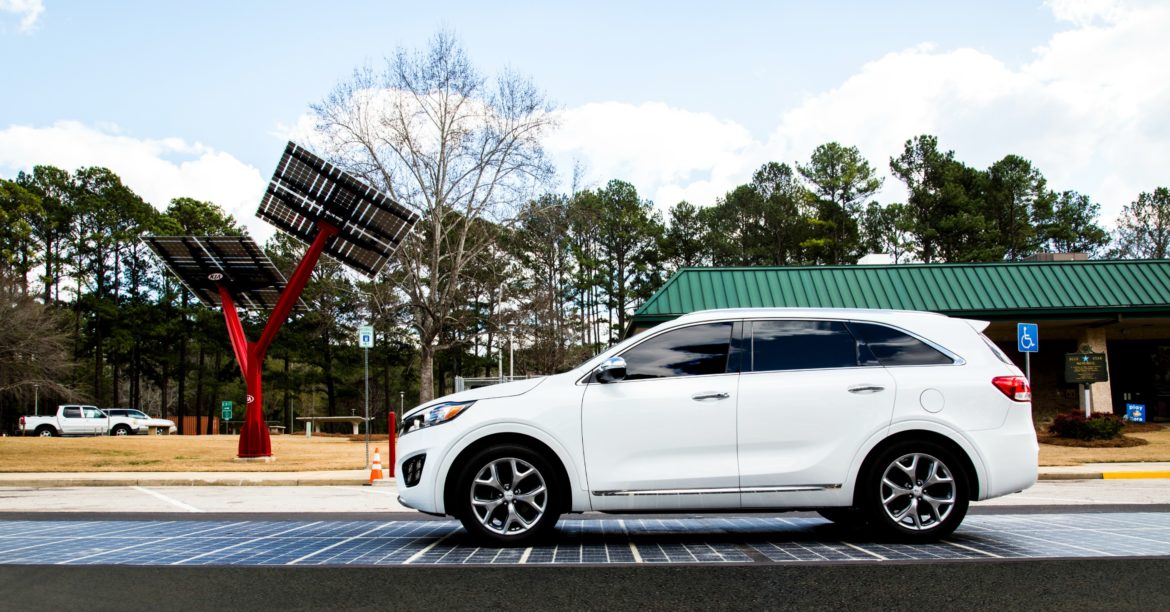 The Ray’s other projects include a solar-powered electric vehicle charger sponsored by automaker Kia.
Introducing interactive and photovoltaic technologies
Other initiatives by The Ray include a solar-powered electric vehicle charging station (supported by the car manufacturer Kia), pollinator plants for ground cover on “underleveraged” Georgia Department of Transportation land, Wi-Fi-enabled way stations to check tire pressure, and by the end of 2019 a 1-megawatt solar array, which has been approved by the Public Service Commission and will be installed by Georgia Power.
“We’re planning to construct an array there,” Kelly added, referring to the 412 acres of vacant, single-use land along the highway. “We’re just the third state to take this action, and it will aid other states in assessing their own interstate real estate potential,” contributing to green highways development.
“We look forward to learning useful knowledge with this pilot project on the possibilities for solar generating along the roadway,” said Georgia Power spokesperson John Kraft.
The benefits of solar powered EV chargers may potentially be financially viable. Every visitor can use the free solar-powered electric car charger at The Ray. Georgia already has 25,000 electric vehicles, and if they grow more accessible and desirable, the state may someday make money from electricity sales as fuel tax income drops.
Republican state representative Todd Jones from Georgia’s District 25 in the Atlanta region anticipates a significant increase in the number of electric vehicles in the state. By 2020 and 2025, automotive batteries will be able to go 500 and 1,000 miles, respectively.
One day, electric vehicle charging stations at exit ramps may be powered by solar trees.
Costas Simoglou, director of the Georgia Center of Innovation for Energy Technologies, stated, “We are in negotiations with Georgia Tech to conduct a research on the cost of placing panels at exit ramps along The Ray, along with EV charging stations. The theory is that if you continue to see this technology and charging stations, you could be persuaded to buy an electric car as your next vehicle.”
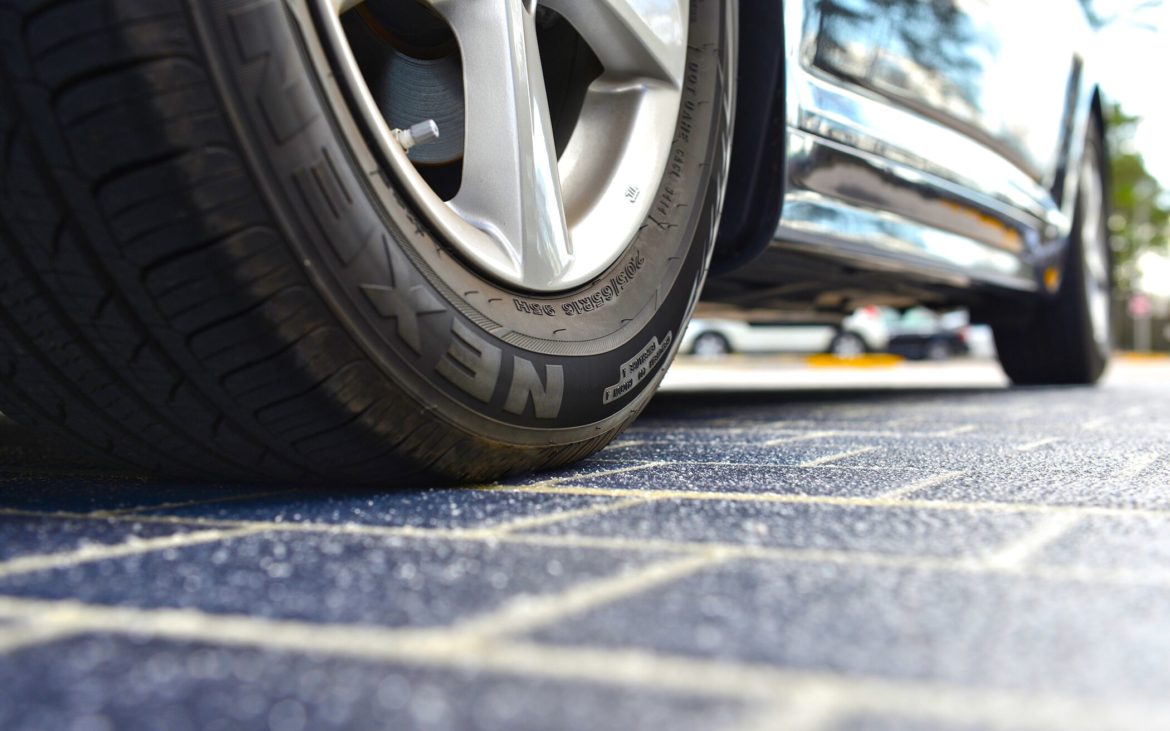 The Ray has also installed a system to measure tire pressure and tread wear.
Using automated tire pressure testing to reduce carbon
According to a study by Georgia Tech University researchers, vehicles on The Ray’s brief section create 250 tons of emissions per day, use 9.4 million gallons of gasoline annually, and generate an average of 70 decibels of noise pollution, which disturbs local animals. This highlights the ongoing need for emissions reduction strategies.
According to Anna Cullen, director of external relations and communications at The Ray, the United States Department of Transportation estimates that nearly two billion gallons of fuel are lost annually as a result of underinflated tires. In order to address this, The Ray Project has put in place a system designed by WheelRight in England, in which users gently drive their cars over hidden sensors. The sensors take an immediate reading of the tire pressure and tread depth and text the driver. This automated tire pressure testing technology is a first for the United States and, if implemented on a bigger scale, might aid in reducing total fuel use. WheelRight sensors at The Ray’s welcome center had examined 18,500 tires as of November 2018.
What Echols liked about The Ray’s strategy was their willingness to use foundation funds to assist launch their own concepts. “The state just gives the space and the right-of-way together with its collaboration. The Ray’s board is garnering interest from all around the world since it started off tiny and tried so many different ways.”
Recent Posts
-
Vũ Phong Magazine – September 2026: Strategic Partnerships and Green Energy Transition in Focus
-
C47 Inaugurates Representative Office in Laos and Announces the Establishment of C47 Energy Laos: A Strategic Milestone in Its International Expansion
-
Solar Energy Businesses Strengthen Cooperation to Expand the Renewable Energy Solutions Ecosystem
-
 Energy is becoming a new competitive advantage for manufacturing businesses
 -
Vũ Phong Energy Group Advances Energy Infrastructure for the AI and Data Center Era On July 29, as part of the Vietnam Global Innovation Connect 2026 (VGIC 2026), Vũ Phong