According to the IEA (International Energy Agency), global renewable power growth is projected to rise rapidly over the next five years, accounting for approximately 95 percent of the increase in worldwide power capacity through 2026. Renewable power capacity will expand by more than 60% between 2020 and 2026, reaching more than 4,800 GW.
- International cooperation – Vietnamese enterprise’s “key” in the field of wind power
- Optimizing operation activity and increase value for wind power plants
- Vu Phong Energy Group proactively implements many activities in the midst of the Covid-19 Pandemic
Renewable energy achieves a new record despite Covid-19 and growing costs
In 2021, Covid-19 continued to pose a significant challenge to the global economy. Despite many nations shifting towards treating Covid-19 as an endemic rather than a pandemic, thanks to mass vaccination campaigns and strategies for safe adaptation to control the pandemic while recuperating and strengthening the economy, the direct effects of Covid-19 on the global supply chain, particularly the renewable energy industry, included increased logistical costs and prolonged clearance times. These factors created notable `renewable energy challenges opportunities Covid-19` for the sector.
Challenges and Opportunities for Renewable Energy amid Covid-19 and Supply Chain Disruptions
Not only facing challenges from the Covid-19 epidemic, but the supply chain for the renewable energy industry, particularly solar power, also experienced significant strain. This was a result of the United States imposing import restrictions on solar cell materials from several companies in Xinjiang, China, and widespread power outages across China. The price of silicon and polysilicon, along with other raw materials such as PV tempered glass, EVA plastic, aluminum, steel, and copper, increased rapidly, driving up the price of solar power modules and wind turbines. Many European and American wind turbine manufacturers announced price hikes ranging from 10% to 25% for new orders. According to the International Energy Agency (IEA), investment costs for concentrated solar and onshore wind power were expected to be 25% higher than in 2019, impacting overall `renewable energy capacity` expansion.
- Investing $226 billion in renewable energy in the first half of 2022
- Green energy costing is expected to reach nearly $650 billion in 2022
- Vu Phong Energy Group donated VND 100 million for the first phase which will be used to purchase a Covid-19 vaccine
Higher natural gas and coal prices, however, simultaneously improved the competitiveness of wind and solar electricity, showcasing the dynamic `renewable energy market analysis`. Renewable energy continued its impressive development in 2021. According to the IEA’s assessment in early December 2021, with approximately 290 GW added, 2021 was a record-setting year for additional `renewable energy capacity`, exceeding the already exceptionally strong growth rate of 2020 by 3 percent. Solar energy accounted for more than half of the total increase in renewable electricity in 2021, highlighting substantial `solar power expansion`, followed by wind energy and hydroelectricity, reflecting strong `wind power development` globally.
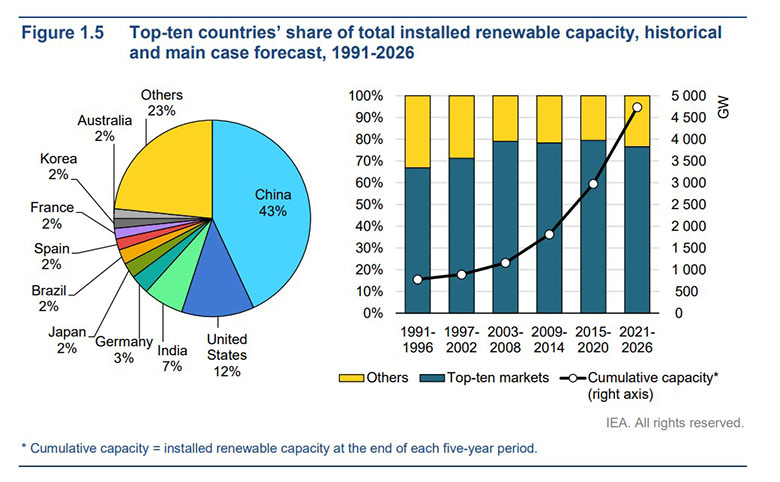 Top countries for renewable energy capacity (Source IEA)
The future predictions for clean energy
According to the International Energy Agency (IEA), `renewable energy capacity` will grow faster over the next five years, accounting for about 95% of the growth in global power capacity through 2026. Between 2020 and 2026, renewable power capacity is projected to expand by more than 60%, reaching over 4,800 GW, a significant `IEA renewable energy forecast`. China, Europe, the United States, and India are identified as the largest markets, collectively accounting for 80% of global `renewable energy capacity` expansion and shaping the `future of power generation outlook`.
Some `IEA predictions global clean energy 2026` for the period 2021-2026 include:
– Renewable power output will increase by approximately 52%, reaching more than 11,300 TWh in 2026; renewable energy will become the largest source of power generation, indicating significant `clean energy projections`.
– Additional annual renewable capacity of 305 GW in the base scenario and more than 380 GW in the growth scenario, contributing to overall `energy transition trends`.
– In the base scenario, solar power will account for 60% of total extra renewable energy capacity, with about 1,100 GW, demonstrating continued `solar power expansion`.
– The annual additional capacity of offshore wind power is projected at 21 GW, with onshore wind at 75 GW, underscoring `wind power development`.
– Offshore wind power is expected to have the fastest growth rate (240%) of all renewables, a key aspect of `power generation forecast`.
– The cumulative capacity of offshore wind power will reach nearly 120 GW by 2026 in the base scenario, potentially reaching 134 GW in the growth scenario.
However, the IEA emphasizes that a substantial gap remains between these projections (in both the base and growth scenarios) and the trajectory required to reach the `Net Zero 2050 targets`. Achieving these `sustainable energy solutions` will necessitate that `global renewable power growth` in 2021-2026 be 80 percent faster than the current growth scenario, further driving `the energy transition trend in Vietnam` and globally.
*Source: Renewable Energy Report 2021 – Analysis and Forecast to 2026, IEA
|
To review the overall picture of the world and Vietnam’s renewable energy markets in 2021, as well as the critical milestones and impressive achievements of Vu Phong Energy Group in the previous year, please visit Vu Phong Magazine Special Edition – 2021 HIGHLIGHTS. |
Vũ Phong Energy Group
Recent Posts
-
Vũ Phong Magazine – September 2026: Strategic Partnerships and Green Energy Transition in Focus
-
C47 Inaugurates Representative Office in Laos and Announces the Establishment of C47 Energy Laos: A Strategic Milestone in Its International Expansion
-
Solar Energy Businesses Strengthen Cooperation to Expand the Renewable Energy Solutions Ecosystem
-
 Energy is becoming a new competitive advantage for manufacturing businesses
 -
Vũ Phong Energy Group Advances Energy Infrastructure for the AI and Data Center Era On July 29, as part of the Vietnam Global Innovation Connect 2026 (VGIC 2026), Vũ Phong